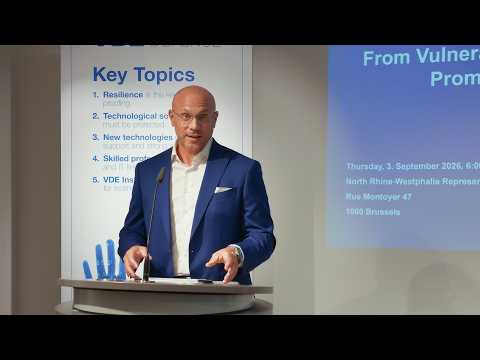
The first workshop day of EFTS 2026 culminated in the political and social highlight of the event, the VDE Summer Reception Brussels 2026.
Held at the Representation of the State of North Rhine-Westphalia to the European Union in Brussels, the reception brought together representatives from European institutions, industry, academia, diplomacy, and the engineering community. The topic of the evening resonated strongly within Brussels' policy circles, and demand significantly exceeded the available seating capacity.
In his opening address, Markus B. Jaeger, Global Head of Political Affairs at VDE and Head of VDE Defence, described resilience as the defining security policy challenge of this decade. Referring to the growing number of attacks on critical infrastructure, cyber systems, and democratic processes, he argued that Europe can no longer separate technological progress from questions of security. Resilience, he stressed, has become a fundamental prerequisite for freedom, prosperity, and democratic stability.
Speaking candidly about Russia, he stated: “We are not at war, but neither are we living in peace any longer. The number of hybrid attacks and acts of sabotage continues to increase. These attacks are attributed to actors originating from Russia’s sphere of influence and threat environment. Resilience is therefore a strategic necessity. Technology, innovation, and trusted standards are fundamental pillars of Europe’s security and defence capabilities.”
Welcoming guests on behalf of the State Representation, Rainer Steffens, Head of the Representation of the State of North Rhine-Westphalia in Brussels, highlighted North Rhine-Westphalia’s position as one of Europe’s leading industrial and technology regions. He emphasised the importance of close dialogue between policymakers, industry leaders, researchers, and engineers at a time when technological sovereignty and resilience are becoming increasingly central political objectives. He noted that the State Representation provided an ideal setting for discussions on Europe’s future security and competitiveness.
The keynote address of the evening, entitled “The Resilience Code: From Safety to Resilience”, was delivered by Ansgar Hinz, Chief Executive Officer of VDE.
Referring to the sabotage of communications infrastructure in the Baltic Sea, Hinz illustrated the vulnerability of modern, highly interconnected societies. His central argument was that Europe continues to face significant risks because essential systems are increasingly dependent on digital networks, global supply chains, and critical infrastructures whose interdependencies are often insufficiently understood.
He argued that traditional security approaches are no longer adequate. While prevention remains important, resilient systems must be designed on the assumption that disruptions and attacks may occur despite all protective measures. This led him to distinguish between two concepts:
- Security seeks to prevent attacks.
- Resilience accepts that attacks may succeed and focuses on maintaining essential functions while ensuring rapid recovery.
Hinz described this shift as a transition from “Security by Design” to “Resilience by Design.”
His keynote further examined the cascading effects that failures in critical infrastructure can trigger across interconnected sectors. Energy supply, communications, healthcare, logistics, and financial systems increasingly form a single ecosystem, meaning that disruptions in one area can rapidly spread across many others.
Beyond physical vulnerabilities, Hinz also addressed attacks on societal trust. Disinformation, deepfakes, and coordinated influence operations were identified as equally serious threats because they target not infrastructure itself, but social cohesion and public confidence. Another major focus was technological sovereignty. Europe’s dependencies in areas such as semiconductors, artificial intelligence, advanced electronics, and autonomous systems were described as strategic vulnerabilities.
In response, Hinz presented the mission of VDE Defence, which seeks to strengthen resilience through five strategic pillars:
- Resilient Infrastructure
- Technological Sovereignty
- Future and Key Technologies
- Skills Development and Talent Promotion
- Testing, Certification and Trust
Particular emphasis was placed on the next generation of engineers. The large number of young professionals attending from across Europe were encouraged to view their work not merely as technological development, but as an active contribution to Europe’s future security architecture.
Representing the cabinet of Andrius Kubilius, European Commissioner for Defence and Space, Micha Comnick delivered a comprehensive overview of Europe’s evolving defence strategy. His keynote was entitled “Defence Ready 2030: Europe’s Path Towards Credible Deterrence.” The presentation established a direct connection between supporting Ukraine and safeguarding Europe’s wider security interests. Comnick emphasised the importance of simultaneously strengthening industrial capacity and military readiness. One of his key messages was that support for Ukraine serves several objectives at once: assisting Ukraine’s immediate defence, strengthening the European defence industrial base, and accelerating Europe’s overall defence preparedness. Comnick explained how substantial investments are currently being directed towards the production of ammunition, drones, air-defence systems, guided missiles, and military mobility capabilities. Special attention was given to the concept of industrial readiness. Effective deterrence, he argued, requires not only capable armed forces but also resilient industrial ecosystems that can rapidly expand production during times of crisis.
He also stressed the importance of European cooperation. Fragmented procurement processes, incompatible systems, and duplicated structures continue to reduce Europe’s efficiency. Joint procurement programmes, European research initiatives, and enhanced interoperability are therefore becoming central pillars of European defence policy. Addressing Russia directly, Comnick stated:
“Russia is testing whether Europe can be intimidated, divided, and deterred from action. Our response is to strengthen our resilience and enhance our deterrence. Not only to prevent war, but also to prevent attacks below the threshold of armed aggression, such as the one we experienced in Leipzig. Attacks must fail, those responsible must be exposed, and aggression must carry costs. Our answer is Ukraine: the capacity to resist today and the industrial partnership that strengthens Europe for tomorrow. And our answer is Readiness 2030: spending more, spending better, spending together, and spending European. Ukraine is buying us time. Industry transforms that time into readiness. Readiness creates deterrence.”
Comnick concluded his keynote with a clear message: “Deterrence is built on readiness, and readiness is built on industrial resilience.”